PIC
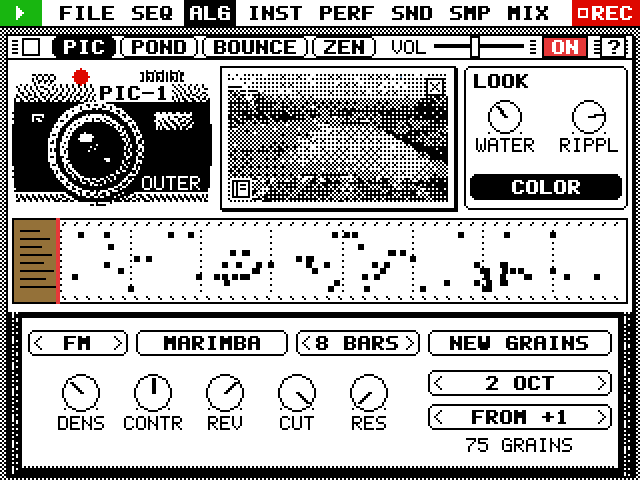
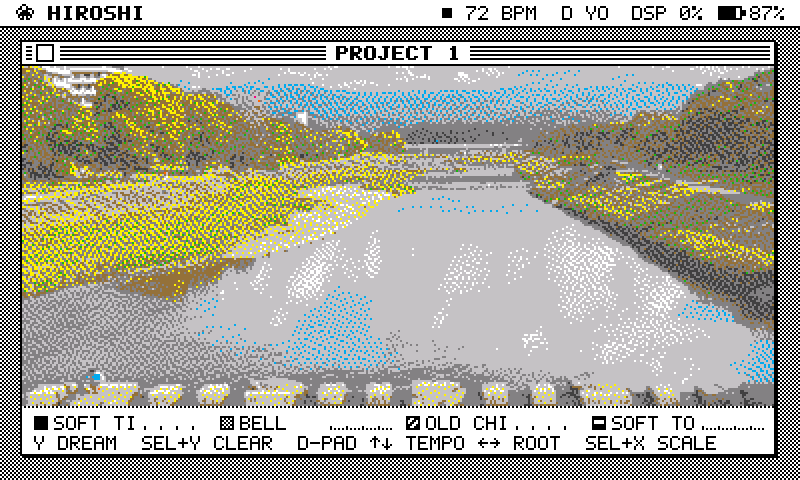
A photo becomes a score.
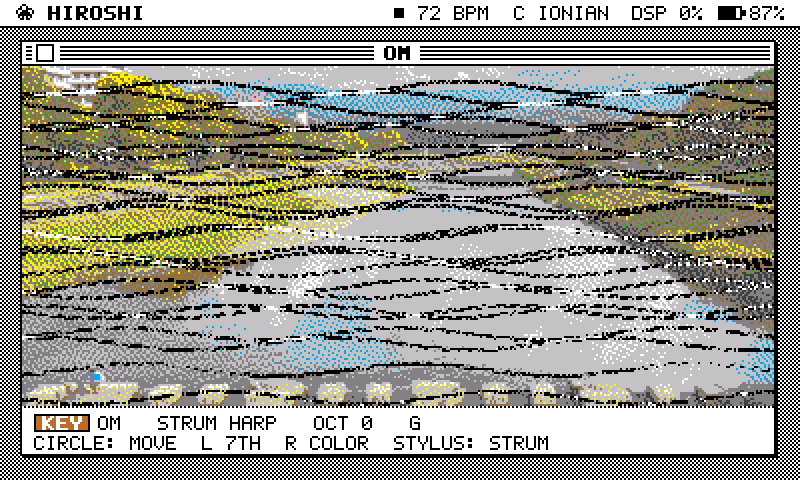
Take a picture with the console's camera and Hiroshi reads it as a rain of sound grains.
FOR NEW NINTENDO 3DS
 Hiroshi.
An ambient music workstation that fits in your pocket.
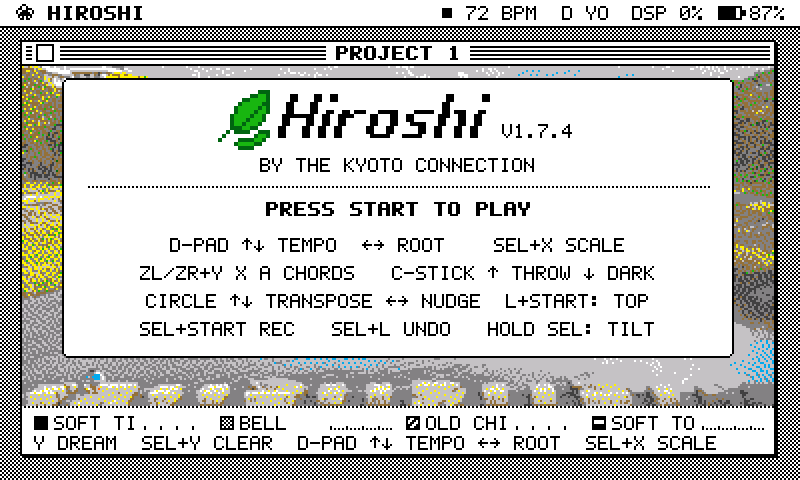
Four playheads. One grid. Music that never plays the same way twice.
SEQ
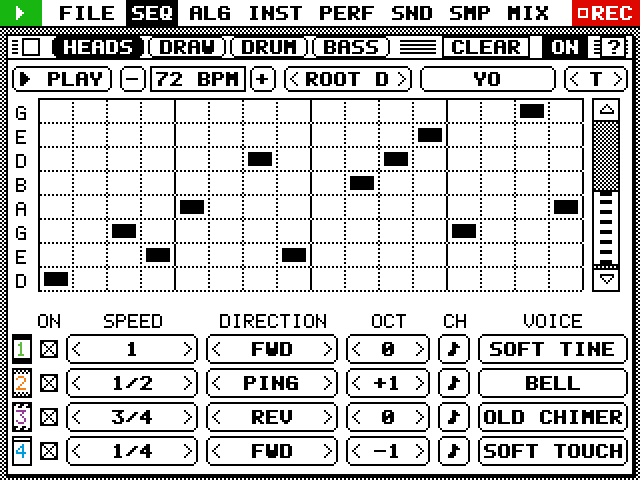
Draw notes with the stylus on a grid that's already in key, so there's no wrong note. Four playheads run across it at once, each with its own speed, direction and octave.
The grid holds two octaves, one in sight, with a scroll bar like the first Mac's to move between them. Out of ideas? Press Y and Hiroshi dreams a pattern up for you.
DRAW NEW
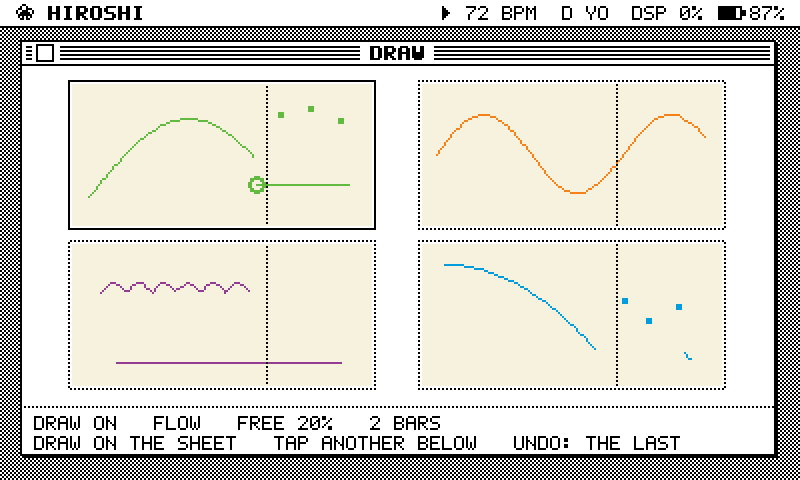
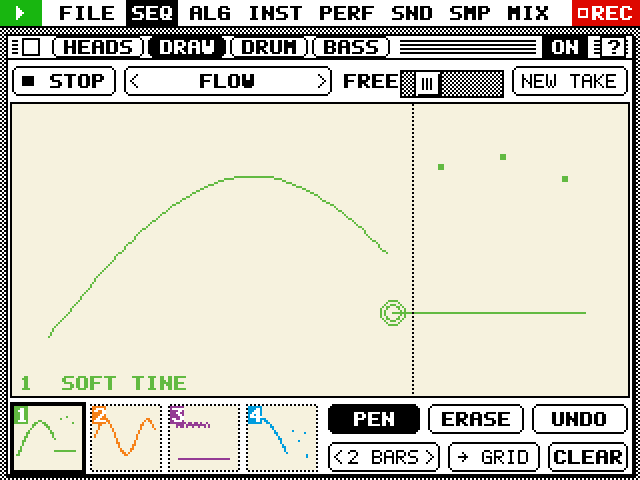
Four sheets of paper, one for each playhead. Draw lines, curves and dots, and Hiroshi reads them like a pictorial score: higher on the page is higher in pitch, and left to right is time.
ALG
Build a system and let it live. A photo, a pond, a few bouncing balls. All in time, all in your key.
Take a picture with the console's camera and Hiroshi reads it as a rain of sound grains.
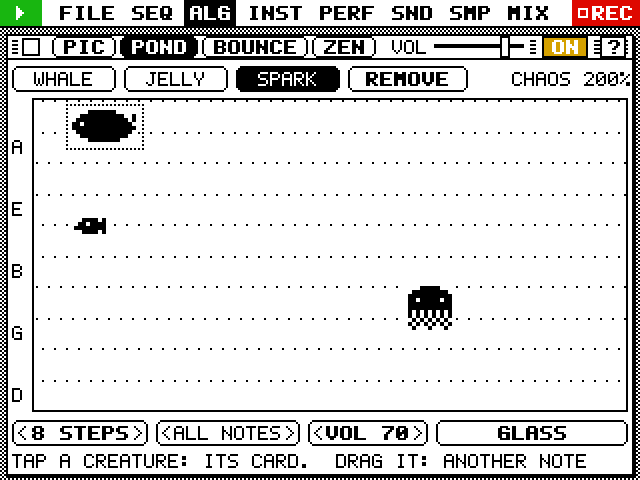
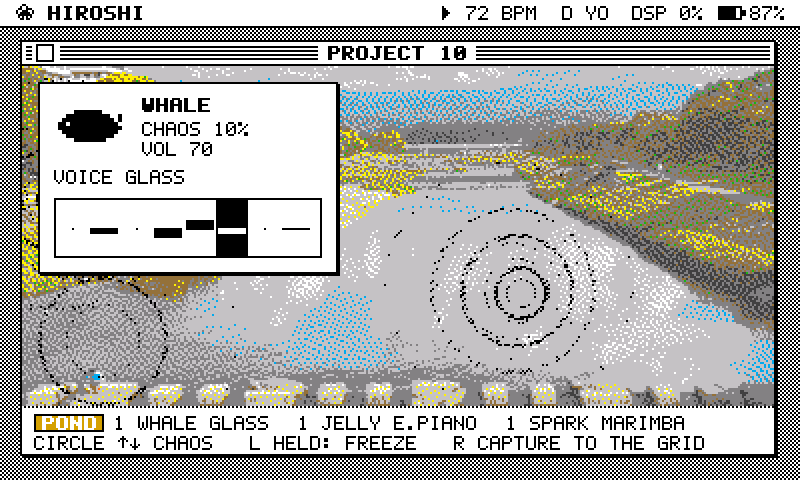
Whales, jellyfish and spark fish swim in a pond, singing phrases that mutate. Like one? Capture it to the grid.
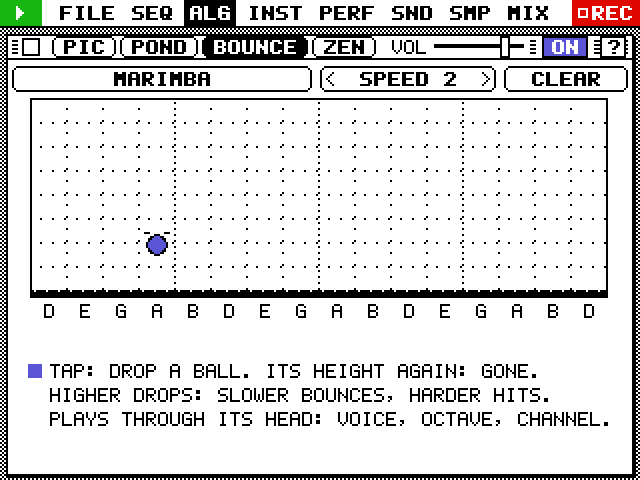
Tap to drop a ball. The higher it falls, the slower it bounces and the harder it hits.
ZEN
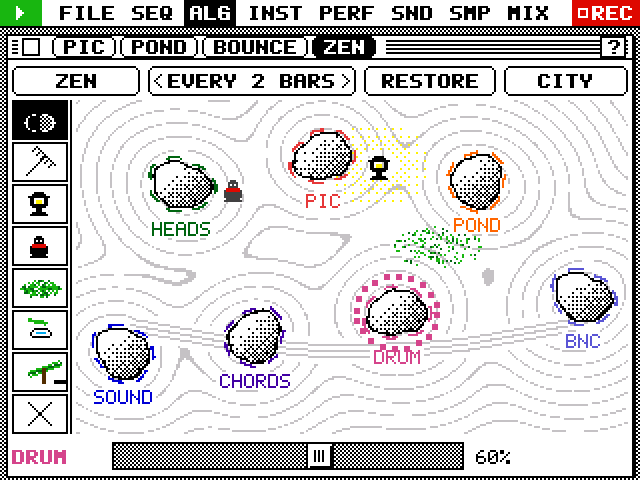
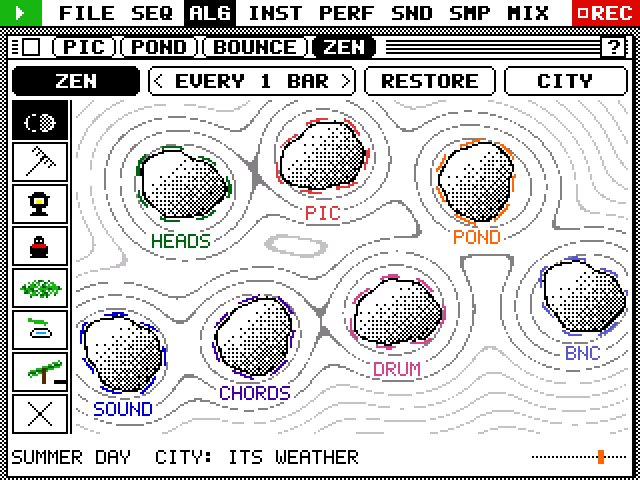
Every part of your song is a stone in a raked gravel garden, and its size is how much it may change. Design it once and the piece evolves on its own, slowly, within bounds.
SND
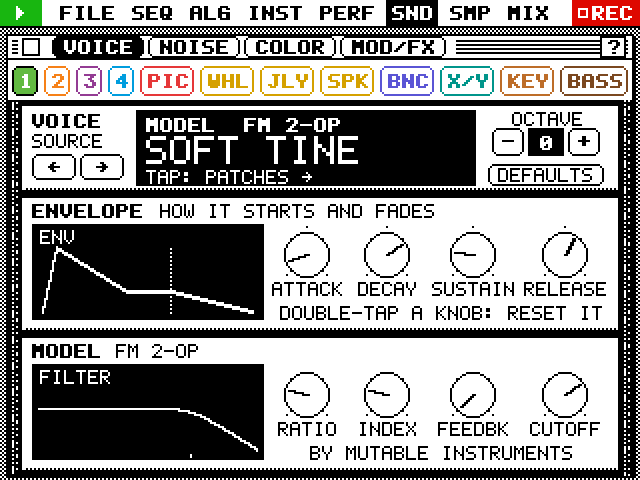
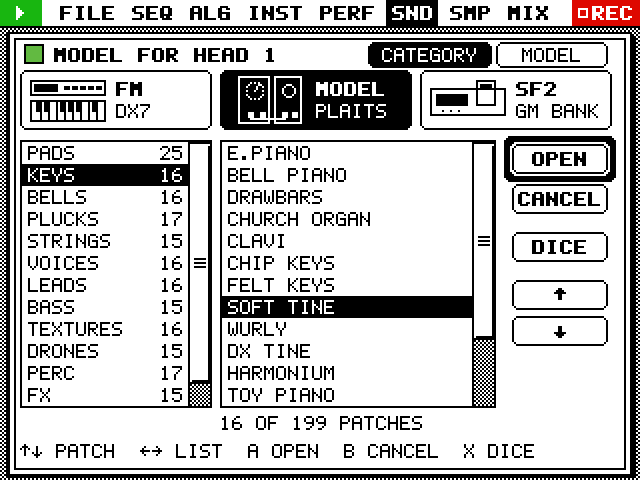
The same synthesis core as Dexed. Hand-picked, one by one, by ear.
Mutable Instruments' macro oscillator, with 199 patches built from its manual.
Drop an .sf2 on the card and any playhead, creature or ball can play it.
Envelope, filter, brightness and vibrato for every source. NOISE adds air under each note. COLOR roughens it up with a bitcrusher and a ring modulator. And each channel's own LFO makes it breathe.
Save what you make to USER and it follows you into every project. DEFAULTS takes you back to where you started.
INST
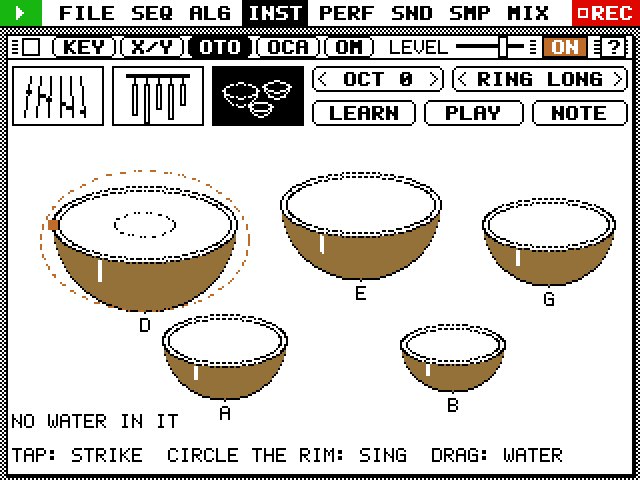
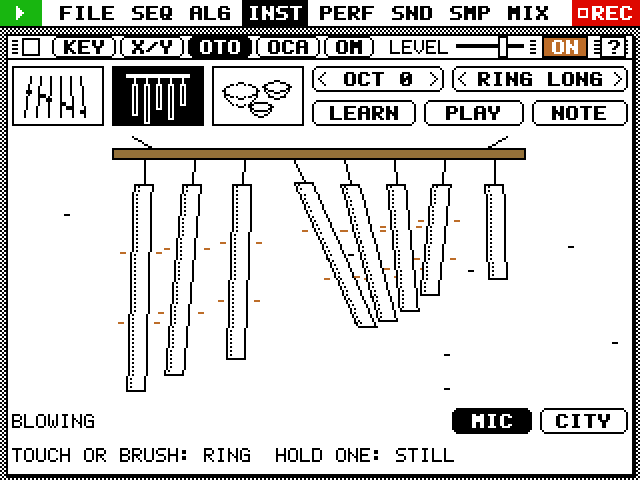
The stylus, the microphone, the Circle Pad. Everything you play follows the key of your song, and leaves its mark on the photo up top.
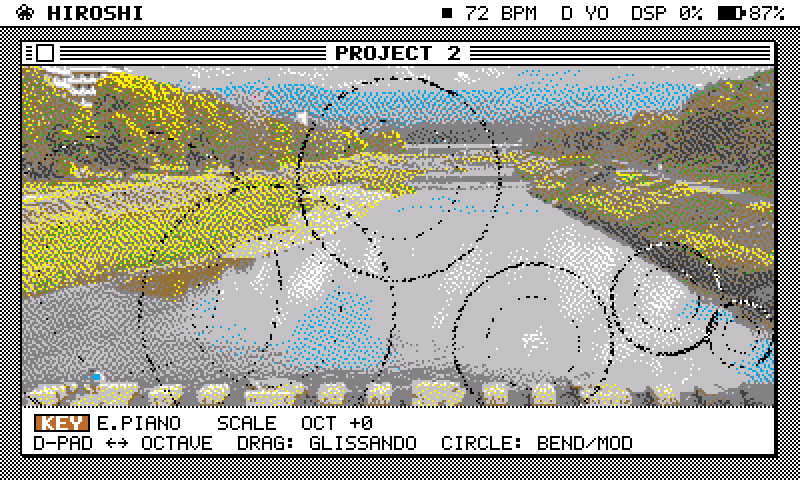
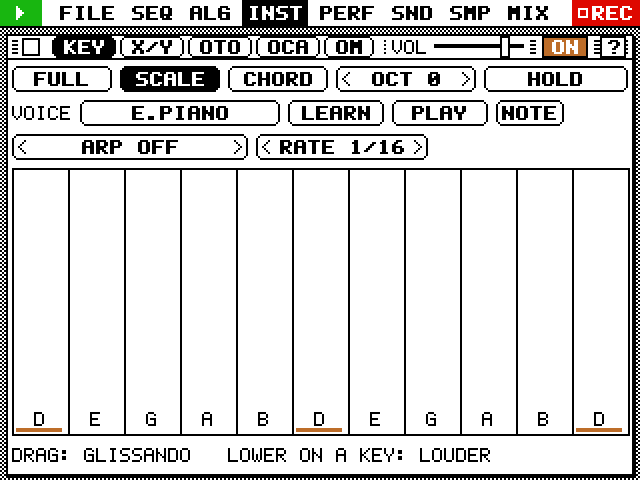
A keyboard in your scale, or in chords, with an arpeggiator. Each note falls on the photo up top and opens a ring: low notes on the left, high on the right, wider the harder you play.
PERF
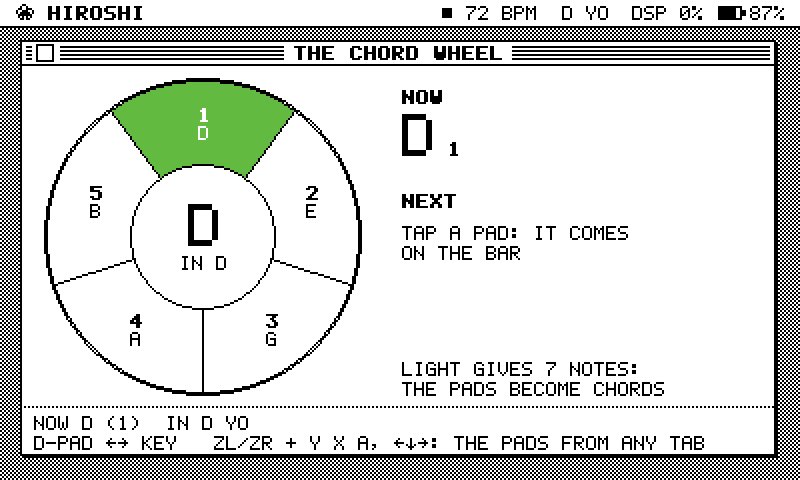
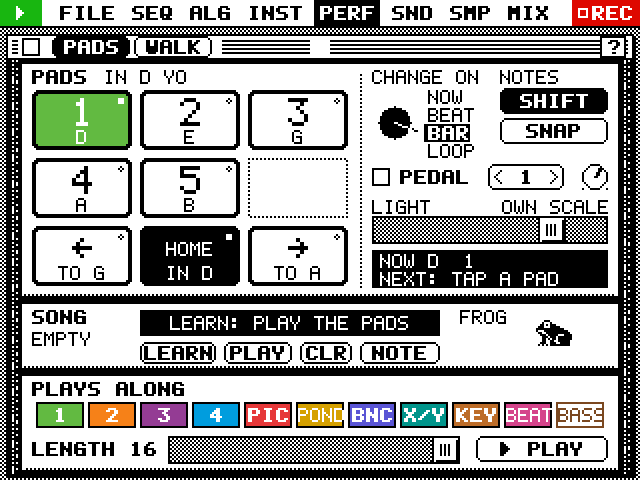
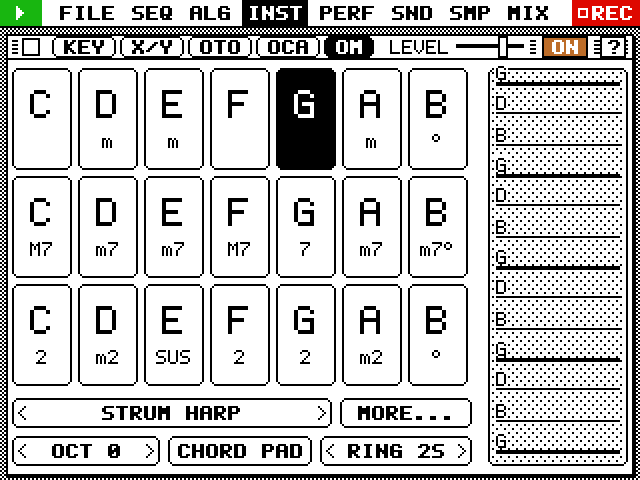
Six pads hold the chords of your key. Tap one and the whole project follows: playheads, creatures, balls, the bass. Up top, the chord wheel shows what's playing and what comes next.
Change key by fifths, teach it a song to play back, or let the little frog play on its own. From any screen, with ZL/ZR + Y X A.
WALK NEW
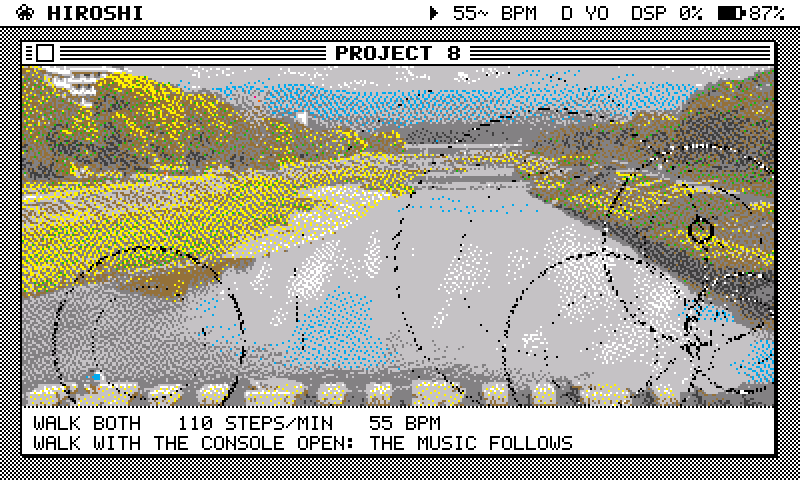
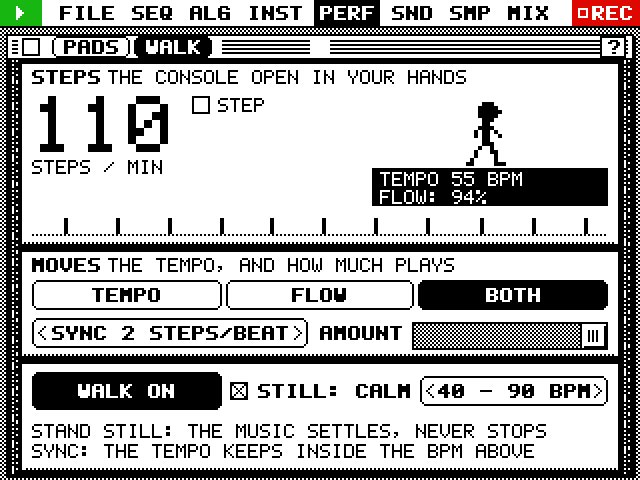
Walk with the console open in your hands. Hiroshi counts your steps, learns your usual pace and makes it the tempo of your song. Speed up and it speeds up with you, gently, never in jumps.
Stop, and the music settles: fewer notes, darker, more reverb. It never stops. When you walk again, everything comes back.
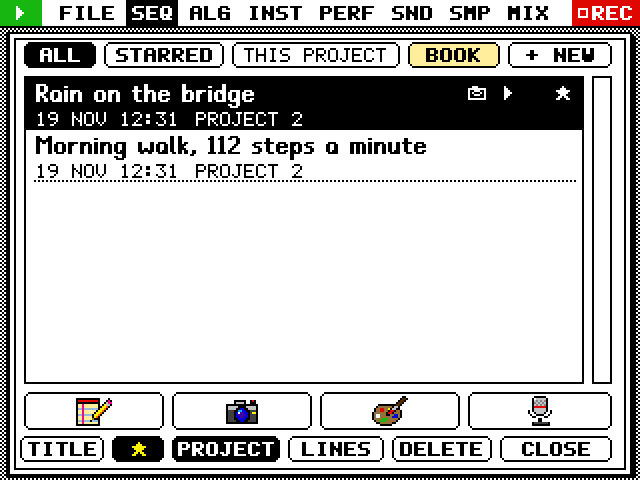
JOURNAL NEW
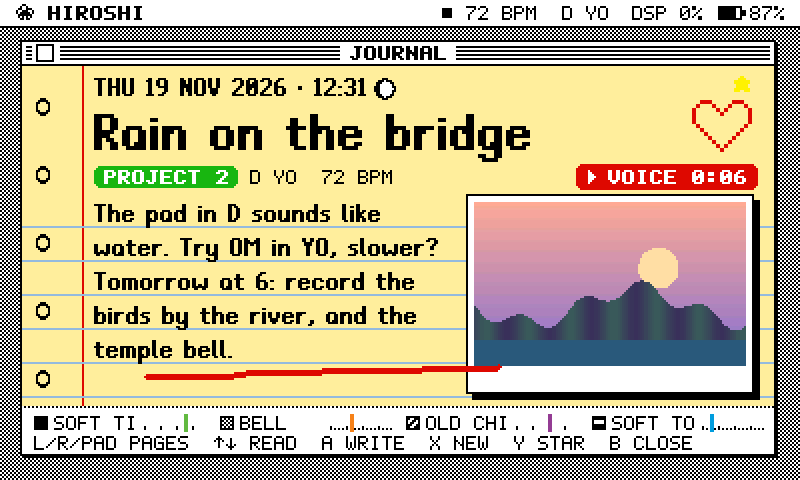
Write in Hiroshi's own handwriting, with its own keyboard. Every page remembers the moment: the date, the moon that night, your city's weather, and the project you were in, with its key and tempo.
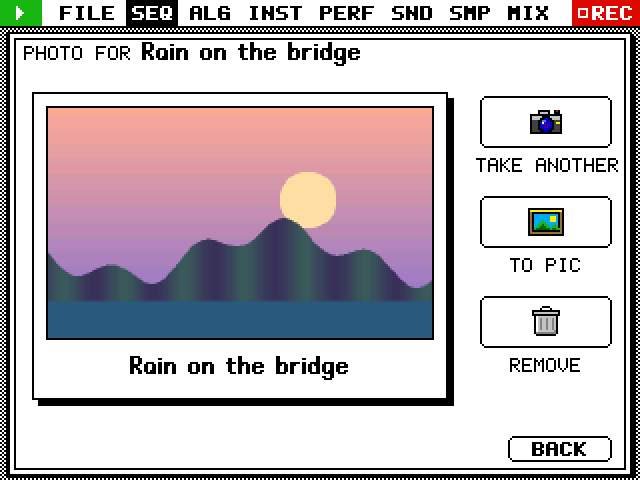
Add a photo, draw or stamp on the page, record a voice note. Then send the photo to PIC or the voice to the sampler, and the idea becomes music.
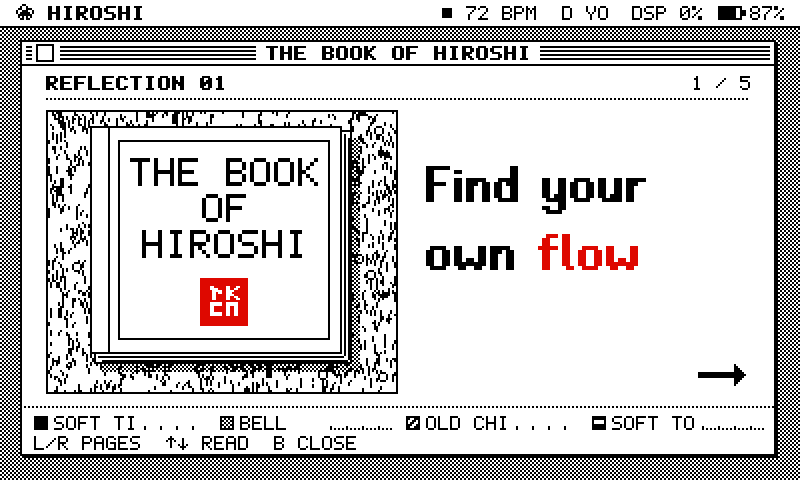
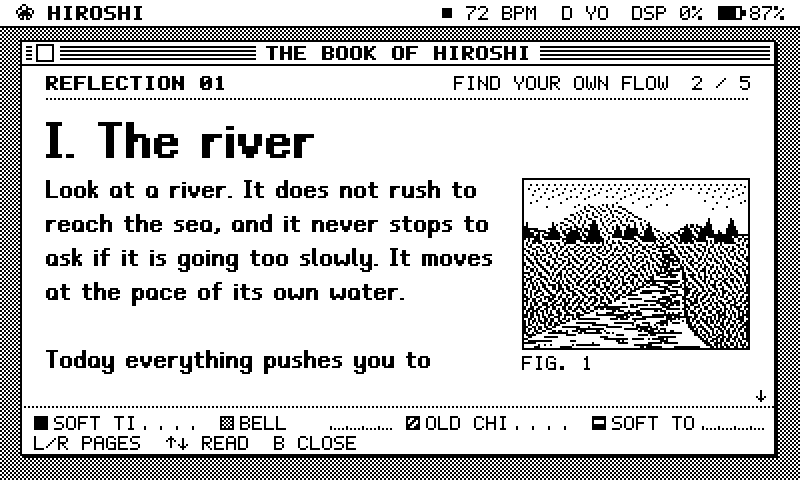
Inside the journal lives a small book: short reflections on music, patience and making things, told by Hiroshi and illustrated in 1-bit.
Hiroshi uses the whole console, not just the touch screen.
Push it up and the whole song rises within the scale. Sideways, slow down or push the tempo, like a hand on a record. In OM, it walks the chords.
Send the sound into the delay and reverb only while you push. Pull down and everything goes dark.
Sample your voice or the mix itself, keep voice notes in the journal. Your breath plays the ocarina and sways the chimes.
Outer camera or selfie: any picture becomes grains of sound in PIC, or a polaroid in your journal.
Your steps set the tempo in WALK. Hold SELECT and tilt it: a current pushes the pond's creatures, the filter darkens, the effects open up. Shake it for a burst of chaos.
Record the mix to WAV on the SD card. The metronome, CLICK, is heard but never recorded.
MIX
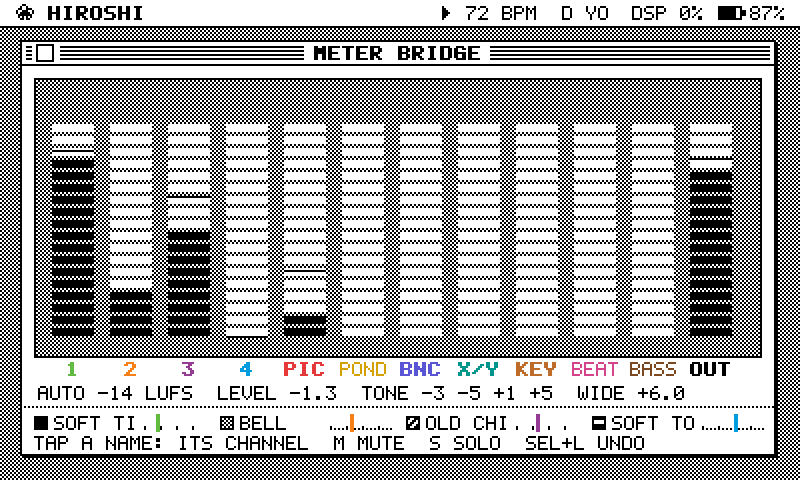
An eleven-channel console and a mastering deck with a 7-band graphic EQ, a cassette, needle VU meters and a radio that tunes in to nature.
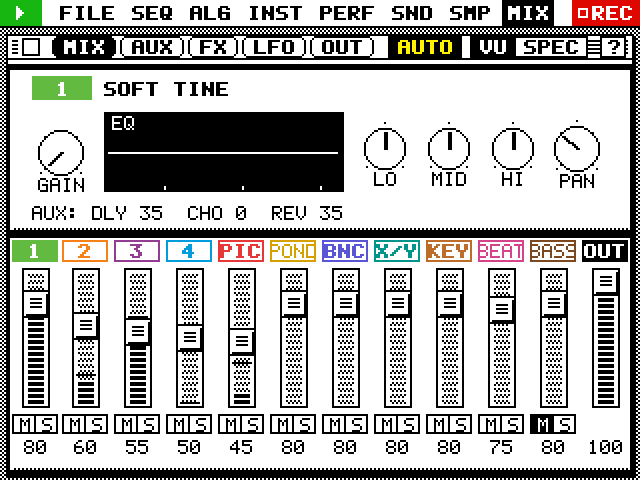
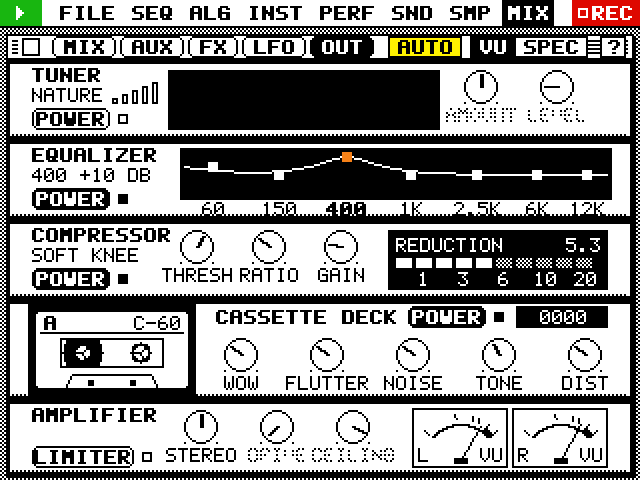
AUTO NEW
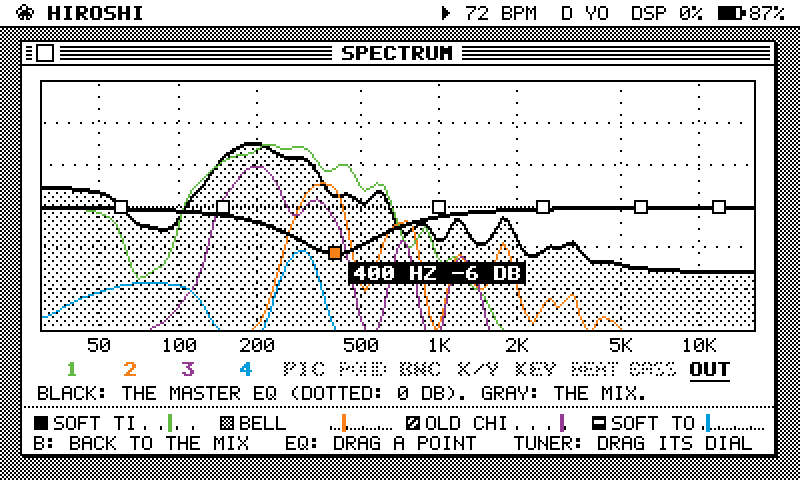
Press AUTO and an engineer joins the session. It measures loudness the way the ear hears it and brings the mix to about −14 LUFS, balances the tone against a well-mastered ambient curve, keeps the lows centered, opens up a narrow mix and never lets a peak past −1 dB.
Hold it to hear the mix without it, at the same volume. And up top, a live spectrum with the master EQ's curve drawn right over it.
DRUM · BASS · SMP
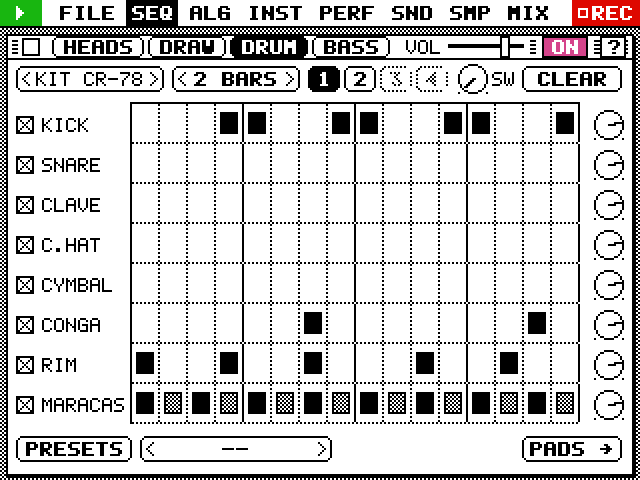
Eight sounds, one to four bars, swing and rolls. 808, 909, CR-78 and DUST kits, and 52 ready-made beats, from rock to candombe.
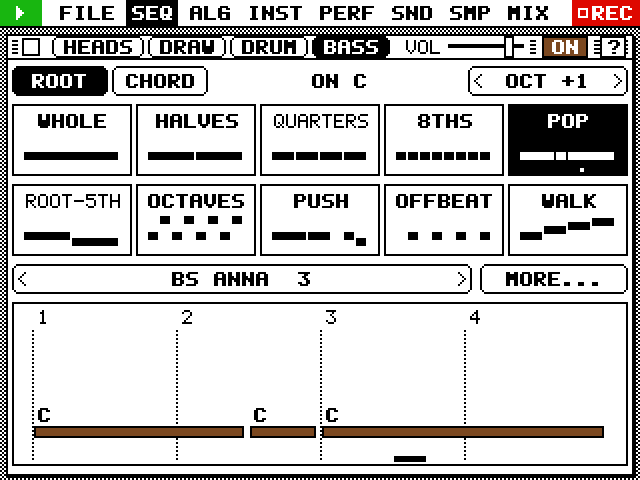
Ten patterns that follow your root or PERF's chords, 32 DX7 basses, its own channel and a compressor that keeps it even.
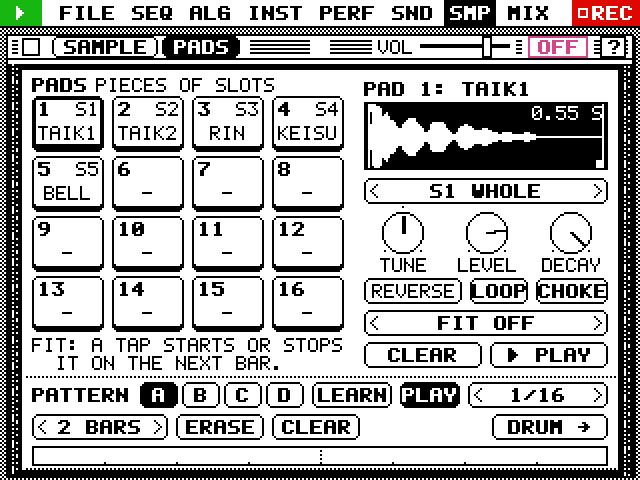
Sixteen pads and four patterns. Every new project comes with five sounds recorded at the Josen-ji temple: two taiko, rin, keisu and a bell.
An interface that looks back to the first Macintosh and to the hi-fi gear of the eighties. Every knob, every cassette, every needle, pixel by pixel. Color only where it means something.
An idea is fragile. Hiroshi takes care of it.
Every two minutes, in the background, whenever something changed. If the battery dies, you lose two minutes at most.
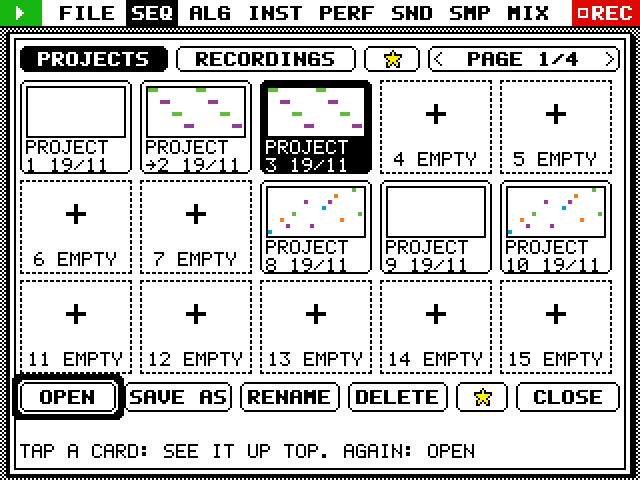
Projects are written to a new file first and only then replace the old one. A damaged project still opens.
A deleted project goes to a trash folder on the card, ready to bring back.
When the processor runs hot, Hiroshi fades out the oldest tails instead of clipping. You hear a few voices fewer, never a crackle.
A 16-second buffer between the music and the SD card. If the card ever falls behind, Hiroshi tells you exactly where.
Run with memory and behavior checkers, against hundreds of damaged projects and long sessions with everything on.

Hiroshi is almost ready. Leave your email and we'll let you know the day it's out.